

A typical biotech startup today has twenty people, one lead asset and a long list of partners. A CDMO makes the drug. A CRO runs the trial. A central lab tests the samples. An EDC vendor holds the data, another vendor handles safety, and a regulatory consultant writes the submissions.
Almost everything is outsourced except one thing: responsibility.
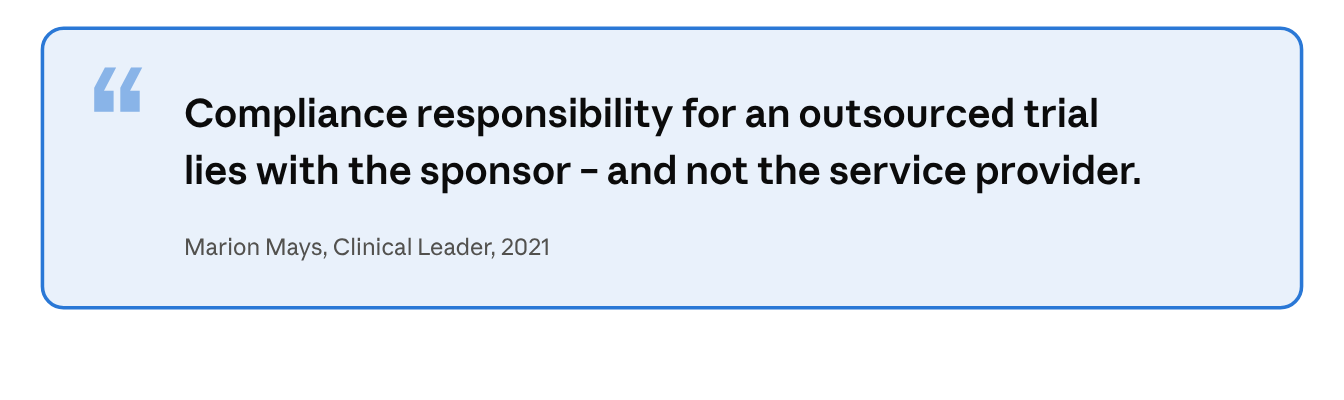
When an inspector arrives, they do not ask the CRO whether the trial was well run. They ask the sponsor how it knows. Writing in Clinical Leader, Marion Mays put it simply: regulators have made it "abundantly clear" that "compliance responsibility for an outsourced trial lies with the sponsor - and not the service provider." Pamela Smith and Diane McGuire made the same point for manufacturing in Pharmaceutical Online: for a virtual company, "the sponsor's primary cGMP responsibility is oversight."
That is the gap. Biotech startups face the same expectations as large sponsors, but with a fraction of the people. Many have no quality function at all until a partner's audit, an investor's due diligence or an inspection notice exposes it. A full-time head of quality is often too much, too early. Doing nothing is too risky. Fractional quality sits in between, and when it is set up well, it closes that gap.
What regulators expect, whatever your size
ICH E6(R3) does not have a small-company version. It is proportionate, but the core duties apply to every sponsor:
-
Transferred work must be documented. Any trial activity a service provider takes on should be set out in an agreement (section 3.6).
-
Responsibility does not transfer. The ultimate responsibility for participants' rights, safety and well-being and the reliability of the data stays with the sponsor (section 3.6).
-
Oversight covers the whole chain. The sponsor oversees important activities transferred to service providers, including work they subcontract further (section 3.6). Oversight includes quality assurance and quality control of what investigators and providers do (section 3.9).
-
Audits are independent. A sponsor audit is separate from routine monitoring and quality control, and checks whether the trial's processes are fit for purpose (section 3.11).
In the US, 21 CFR 312.52 lets a sponsor transfer obligations to a CRO in writing. The sponsor still has to show it knew what it handed over and checked that it was done.
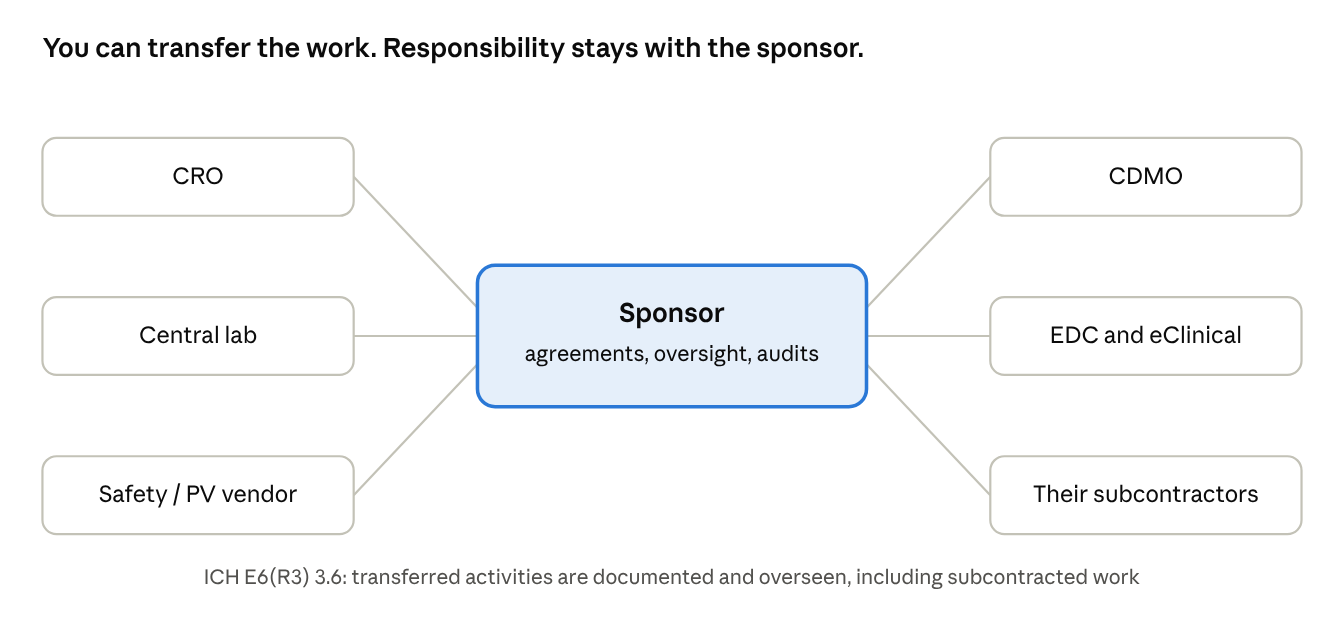
Sponsor responsibility when outsourcing
What inspectors find at small sponsors
The gaps have changed little in fifteen years. At an EMA training workshop for SMEs, a German GCP inspector from BfArM listed findings that still sound familiar:
-
no record of which tasks the sponsor delegated to the CRO
-
the CRO subcontracting tasks without the sponsor knowing
-
one person in several roles, such as a chief medical officer who is also coordinating investigator and audits the same trial
-
monitoring findings with no follow-up
In our own audits of emerging sponsors, the same themes appear, along with a few more: vendors never qualified, a TMF the sponsor has never reviewed, CAPAs owned by the CRO with no sponsor sign-off, and no one who can show an inspector how oversight actually works.
When fractional quality makes sense
Fractional quality means a senior quality professional, or a small team, working part-time as your quality function. They own the QMS, the vendor oversight plan, the audit programme and inspection readiness, for an agreed number of hours each month.
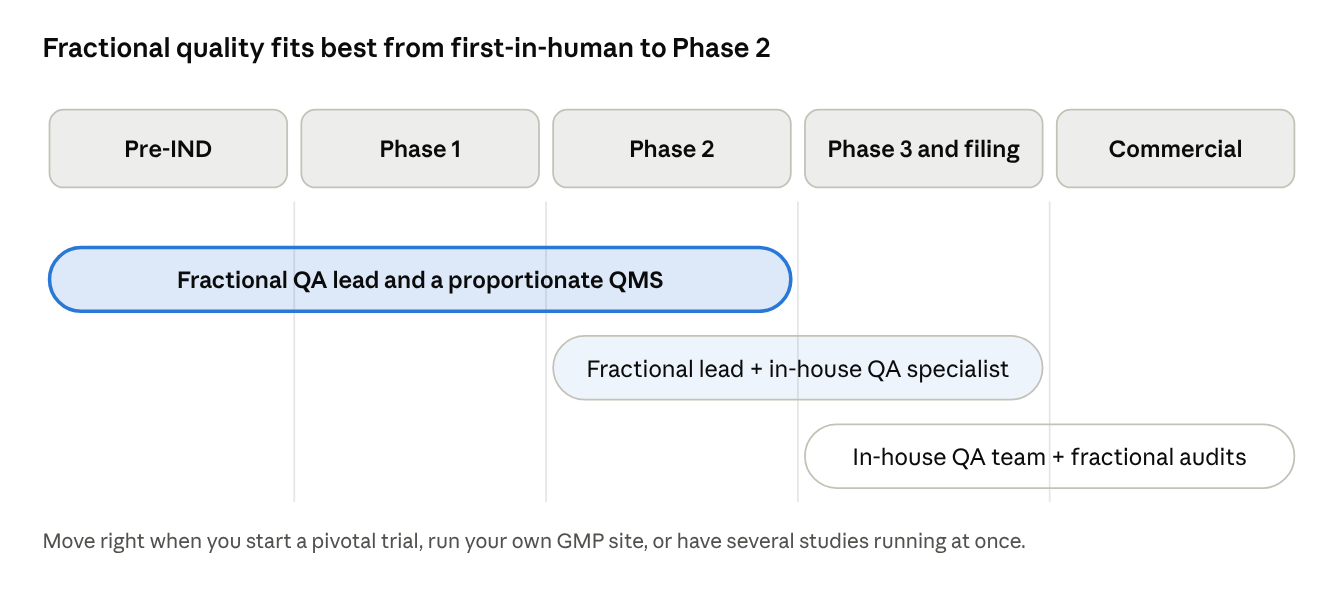
Quality model by development stage
It usually makes sense when:
-
you are pre-IND to Phase 2, with one or two studies running
-
most operations are outsourced, so the work is oversight rather than doing
-
a partner audit, a licensing deal or investor due diligence is coming, and your QMS is thin
-
you need senior judgement (inspection history, CSV, GCP, GMP) more than full-time hours
-
you want a quality function in weeks, not after a six-month hiring search
It is not enough on its own when:
-
you run your own manufacturing or laboratory site that needs daily batch release or QC review
-
you have several pivotal studies at once, or a marketing application under review
-
the regulator expects a named, full-time person in a role, such as a qualified person in the EU or a pharmacovigilance lead
Even then, many companies keep a fractional partner for independent audits, specialist areas such as CSV or data privacy, and peaks like pre-approval inspection preparation. Independence matters here: the person who built your processes should not be the only one auditing them.
What good fractional quality looks like
A fractional model fails when it is just a consultant on call. It works when it is a defined function with clear deliverables. In the first 90 days, expect:
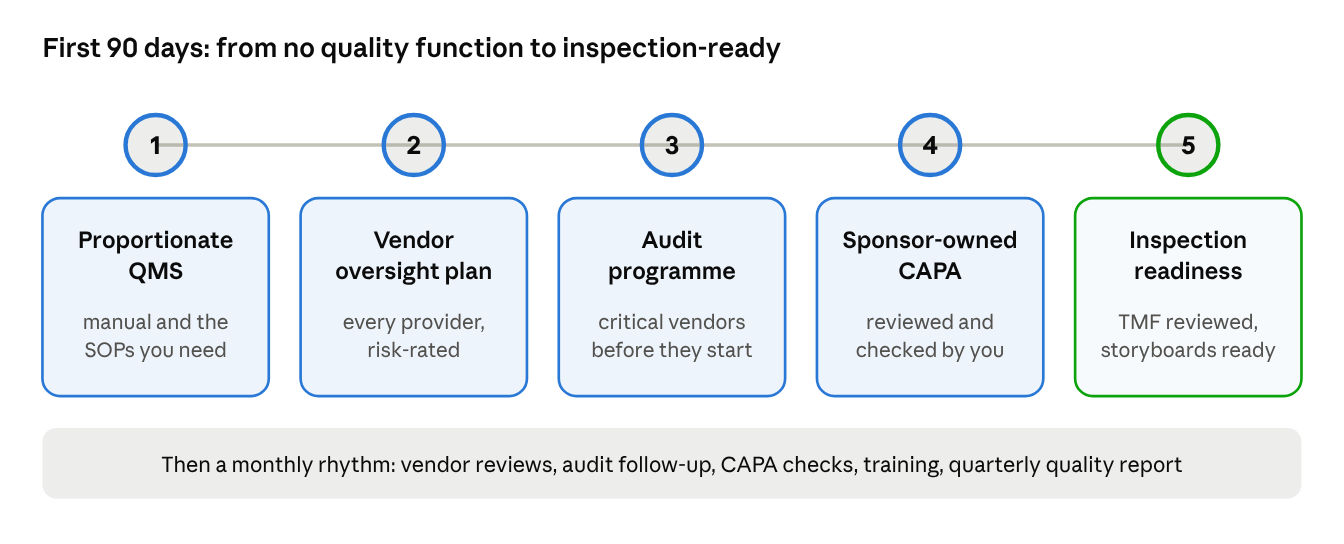
First 90 days of a fractional quality function
-
A proportionate QMS. A quality manual and the 15 to 25 SOPs you actually need, not a copied library of 150. Document control, CAPA, deviations, change control, training, vendor qualification and computerised system validation come first.
-
A vendor oversight plan. A list of every service provider, the activities transferred to each, the risk rating, and how you will oversee them: KPIs, meetings, TMF review and audits. This is the document inspectors ask for first, and the one small sponsors most often lack.
-
A risk-based audit programme. Qualification audits of critical vendors (CRO, CDMO, EDC, safety) before they start work, and investigator site audits where the risk justifies them.
-
A sponsor-owned CAPA and deviation process. Your CRO's CAPAs are evidence, not a substitute. The sponsor reviews, approves and checks the important ones.
-
Inspection readiness from day one. A TMF the sponsor has reviewed, a named person who can explain oversight, and a short storyboard for each critical process.
After set-up, the work becomes a steady monthly rhythm: vendor reviews, audit follow-up, CAPA effectiveness checks, training updates and a quarterly quality report to leadership.
Choosing a fractional quality partner
| Ask | Why it matters |
|---|---|
| Who exactly will do the work, and how senior are they? | You are buying judgement. A senior lead should own the work, not just sign it off. |
| Have they hosted or supported regulatory inspections? | Writing SOPs is easy. Defending them in front of an inspector is not. |
| Do they cover GCP, GMP, CSV and data privacy, or only one? | Biotech startups need all four, often in the same month. |
| How do they keep audits independent? | The person who built a process should not be the only one who audits it. |
| What are the hours, the response time and the escalation route? | A fractional model needs a clear service level, or it becomes "when we get to it". |
| Can they scale up for an inspection or a pivotal study, and hand over to an in-house team later? | Your needs will change. A good partner plans for its own handover. |
In closing
Biotech startups are judged by the same quality expectations as larger sponsors. ICH E6(R3) makes clear that outsourcing work does not outsource responsibility. The practical answer is not to build a large quality department too early, but to establish a proportionate quality function early, led by experienced professionals and designed to grow with the pipeline.
Done well, fractional quality can make partner audits more routine, support due diligence and give leadership a clear answer to the question every inspector asks: how do you know?
Clintask provides fractional QA, QMS implementation and GxP audits for emerging biotech, small and mid-size pharma, and HealthTech and eClinical companies. Our directors have led more than 500 audits and hosted regulatory inspections across the US, Europe and Asia. To talk about your stage and what you need, write to info@clintask.com.
References
Guidelines and regulations
-
ICH E6(R3) Guideline for Good Clinical Practice, Step 4 (sections 3.6, 3.9, 3.10 and 3.11): ICH
-
21 CFR 312.52, Transfer of obligations to a contract research organization: eCFR
Regulator presentations
- Dr Katalina Mettke (BfArM), "GCP compliance", EMA 5th Training Workshop for SMEs, 2010: EMA
Published articles
-
Marion Mays, "Achieving and Maintaining Sponsor Oversight of Outsourced Studies", Clinical Leader, 31 January 2021: Clinical Leader
-
Pamela Smith and Diane McGuire, "Does a Phase 1 Virtual Biopharma Company Need a cGMP Quality System?", Pharmaceutical Online, 7 August 2019: Pharmaceutical Online
-
"QMS for Biotech Startups: A Build vs. Buy Analysis", IntuitionLabs, updated September 2026: IntuitionLabs
Tags: fractional QA, biotech startup, emerging biotech, sponsor oversight, ICH E6(R3), vendor oversight, QMS, inspection readiness