
Open almost any deviation log at a site, CRO or sponsor, and you will find the same three lines repeated:
-
Root cause: human error.
-
Corrective action: staff retrained.
-
Status: closed.
The log looks tidy, but the same type of error may return with a different coordinator, visit or CRF page.
Across more than 500 audits of sites, CROs, sponsors and technology vendors, our directors have seen "retrain" become the default response to deviations. It is easy to raise, quick to close - and often ineffective.
MHRA guidance notes that "human error" should be used as a root cause only after system and process factors have been ruled out, and that simply reminding or retraining the operator is unlikely to be an effective CAPA.
The same concern appears across the industry: human error is often a symptom rather than the root cause. FDA inspection data also highlights the importance of strong investigations and CAPA systems.
ICH E6(R3) gives this approach a firmer footing in GCP.
What ICH E6(R3) changes, and why "retrained" no longer passes
The guideline never uses the phrase "human error". But five of its requirements change what a sponsor, CRO or investigator must show when a mistake happens.
| E6(R3) requirement | What it says | What it means for a human-error CAPA |
|---|---|---|
| 3.12.2 Root cause and CAPA | For noncompliance that significantly affects, or could affect, participants or the reliability of results, the sponsor performs a root cause analysis, implements corrective and preventive actions, and confirms their adequacy unless otherwise justified. | Doing the action is not enough. You need evidence that it worked. A closed "retrained" CAPA with no effectiveness check does not meet this. |
| Principle 6 and 3.10 Quality by design | Factors critical to quality are identified up front, and quality management is proportionate and risk-based. | When an error hits a critical-to-quality step, ask whether the protocol, process or system design made it likely. Match the depth of the investigation to the risk. |
| 2.5.3 Protocol deviations | The investigator reviews deviations and, for important ones, explains them and implements measures to prevent recurrence. The sponsor sets trial-specific criteria for important deviations. | Preventing recurrence is an explicit investigator duty. "Documented and explained" is not the end of the job. |
| Principle 5.1 and 2.3.2 Training | Staff are qualified by education, training and experience, and trial training matches what they need for their delegated activities. | Training should be targeted to the task and the role. Re-reading the whole protocol for everyone is neither proportionate nor effective. |
| 3.10.1.5 Risk review | The sponsor periodically reviews whether risk controls remain effective, taking into account emerging knowledge and experience. | Deviation and CAPA trends should feed back into risk review, monitoring plans and the design of the next study. |
Three practical consequences follow.
First, the effectiveness check is now part of the requirement, not good practice. Under 3.12.2, an inspector can reasonably ask how you confirmed that a CAPA for significant noncompliance was adequate. "Staff retrained on 12 March" answers what you did, not whether it worked.
Second, investigations should be proportionate. A missed signature on a non-critical log may need only correction and a trend check. A wrong randomisation, a late safety report or an ineligible participant needs a proper investigation.
Third, oversight stays personal. In a December 2025 warning letter, FDA judged a clinical investigator's response inadequate partly because retraining covered pharmacy staff, not how the investigator would personally oversee study procedures. And if noncompliance persists, section 3.12.3 expects the sponsor to consider ending the site's or vendor's participation. Repeated "retrained" CAPAs for the same issue are exactly that evidence.
Labels that close an investigation too early
"Human error" is not the only phrase that stops an investigation before it finds anything. These labels appear in deviation logs every day. Each describes what happened, not why.
| Label in the log | What it usually hides | Question to ask next |
|---|---|---|
| Human error | Any of the causes below | What made this error possible, and would another trained person have made it too? |
| Inadvertently missed / inadvertent | A step that relies on memory, with nothing to prompt it | What prompt, checklist or system check was missing? |
| Oversight / overlooked | Workload, interruptions, or a review step that does not exist | Who was supposed to check this, and when? |
| Staff not aware of the requirement | Training not updated after an amendment or a delegation change | Did our training system trigger when it should have? |
| Miscommunication | Unclear amendment, poor handover, CRA or staff turnover | How was the change communicated, and how did we confirm it was understood? |
| Lack of attention / carelessness | Fatigue, workload, a confusing form or screen | What in the task or the tool made attention so critical? |
| Site or vendor error | The same problem across several sites or vendors | Is this happening elsewhere, which would point to our protocol or process? |
If the root cause field holds one of these phrases on its own, the investigation is not finished. Keep asking "why was that possible?" until you reach something you can change.
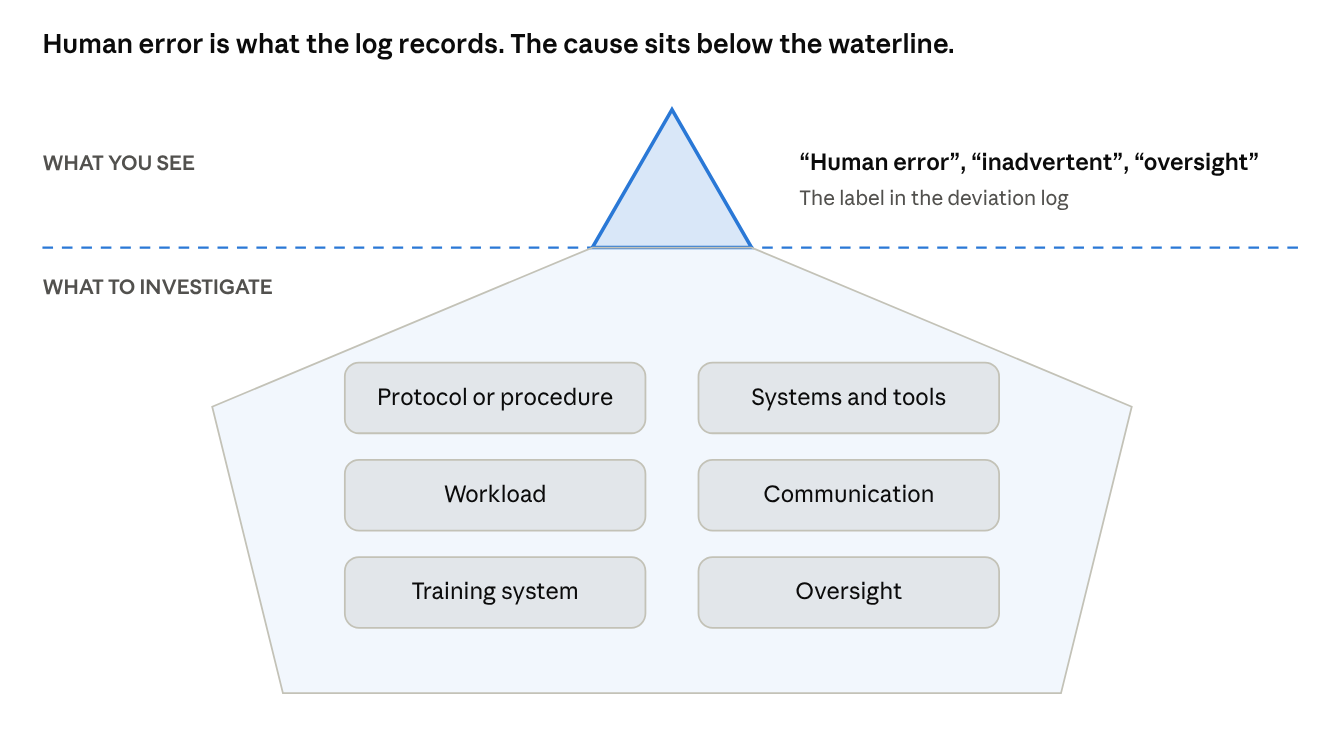
Human error as the tip of the iceberg
The label is the visible tip. A finished investigation names something below the waterline that the organisation can change.
A better human-error investigation in five steps
Human error is the starting point, not the conclusion.
-
Describe what happened, not who did it. Capture the facts, timeline, participant, visit, document/system, expected action and actual action.
-
Ask why the error was possible. Look at six areas before settling on "the person":
-
the protocol or procedure (unclear, complex or changed recently)
-
the system or tool (EDC, IRT, eConsent, CTMS)
-
workload and environment (staff shortage, interruptions, many studies running at once)
-
communication and handover (amendments, shift changes, CRA turnover)
-
the training system (was training timely, relevant and checked for understanding?)
-
oversight (why was the issue not detected earlier?)
-
Name the type of error. A knowledge gap, a slip or lapse of attention, and a deliberate shortcut need different fixes. Retraining only fixes a genuine knowledge gap. A tired coordinator who knows the rule will not make fewer slips after re-reading the protocol.
-
Check whether it is a pattern. Look at the same error at other sites, with other staff and in other studies, and at your key risk indicators and quality tolerance limits. A repeat across sites points to the protocol, the eCRF or the sponsor's process, not to one site.
-
Choose actions that change the system. Climb the ladder below; the higher the rung, the less the fix depends on someone remembering.
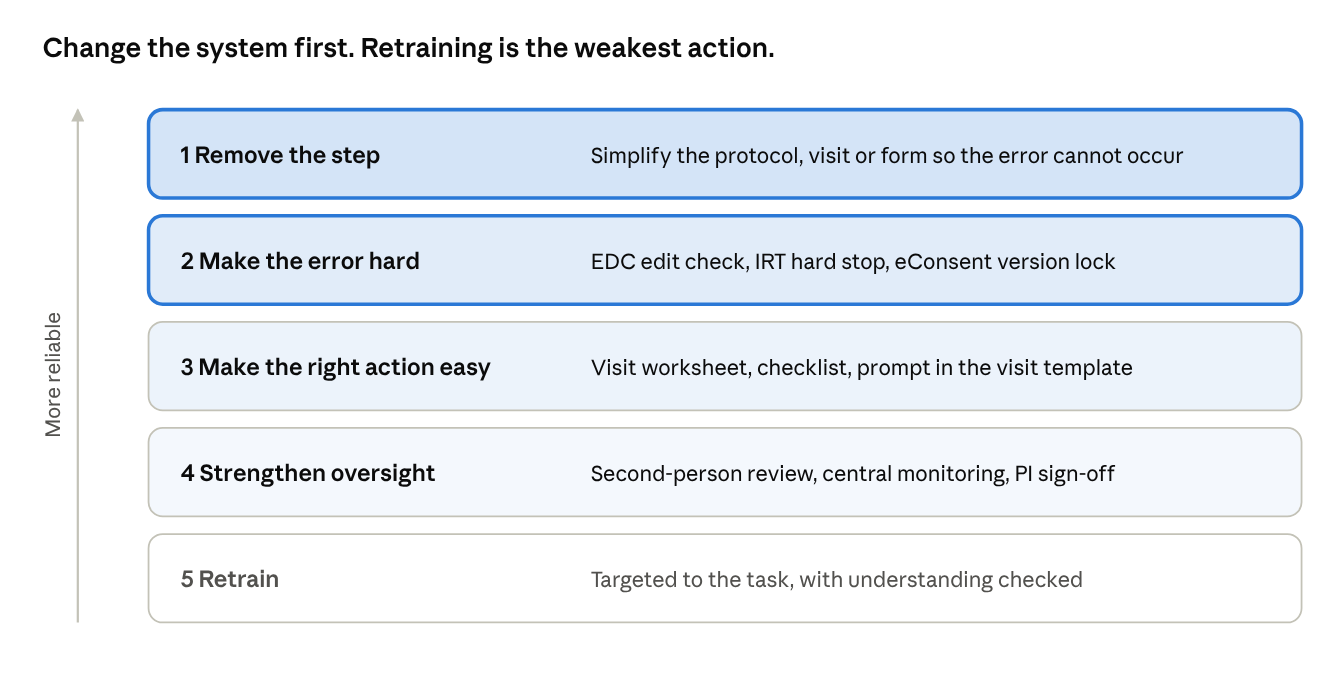
The CAPA action ladder
A good CAPA usually combines two or three rungs. If retraining is the only action, the CAPA rests on memory alone.
What this looks like in practice
| Deviation | Typical CAPA | A CAPA that changes the system |
|---|---|---|
| Superseded consent form version used | Retrain the study coordinator | Remove old versions from the site file; version lock in eConsent; version check on the pre-visit checklist |
| Visit or sample taken out of window | Retrain site staff on the visit schedule | Visit-window calculator or worksheet; scheduling alerts before the window closes |
| Ineligible participant randomised | Retrain the investigator on eligibility | Eligibility checklist tied to source; second-person review of critical criteria before randomisation |
| Serious adverse event reported late | Retrain on safety reporting timelines | SAE prompts in the visit template; weekly reconciliation listing |
When retraining is the right answer
Retraining is not wrong. It is incomplete when used alone. It is the right action when:
-
the person was never trained or was trained on an outdated procedure
-
training was given but never checked for understanding
-
a new role, delegation change or amendment created a training gap
Even then, ask why the training gap existed. A training matrix that is not updated when the delegation log changes is a system problem, and fixing it prevents the next gap as well.
Show that it worked
A CAPA closes when the problem stops, not when the action is done. Define the effectiveness check before closing the CAPA:
-
Measure: for example, consent version errors, or out-of-window visits per 100 visits.
-
Period: long enough to mean something, such as the next three monitoring visits or 50 participants.
-
Target: set in advance, not after looking at the data.
-
Reviewer: someone independent of the person who did the work, such as QA.
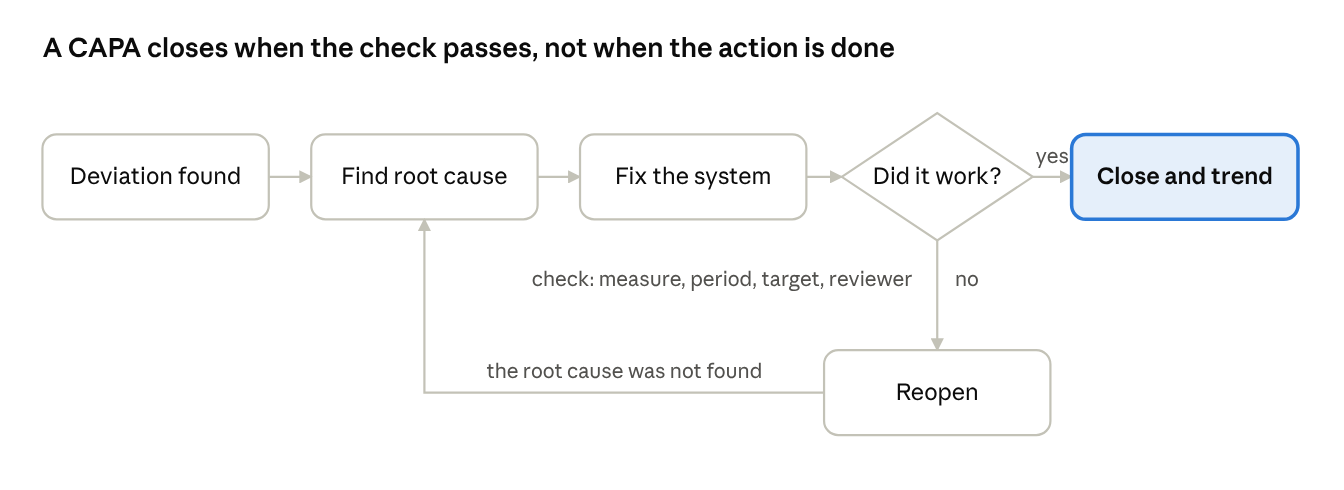
CAPA lifecycle with an effectiveness check
If the check fails, reopen the investigation. A second "retrain" on the same issue is a clear signal that the root cause was never found.
A quick check for your next CAPA review
Before you approve a CAPA that says "human error, staff retrained", ask:
-
Does the root cause go beyond a label, and have protocol, procedure, system, workload and oversight factors been considered?
-
Is this a knowledge gap, a slip or a shortcut? Does our action fit that type?
-
Has the same error happened elsewhere: other sites, other staff, other studies?
-
Does at least one action make the error harder to commit, rather than relying on memory?
-
If training is part of the fix, is it targeted at the people and tasks involved, and is understanding checked?
-
Is there an effectiveness check with a measure, a period, a target and an independent reviewer, so we can confirm the CAPA's adequacy as E6(R3) section 3.12.2 expects?
-
For sponsors: does the deviation trend feed back into risk review, monitoring and the protocol design for future studies?
If any answer is "no", the CAPA is not ready to close.
In closing
ICH E6(R3) asks sponsors, CROs and investigators to think about quality before a trial starts and to keep checking that their controls work. Human-error investigations are one of the clearest places to show that thinking in practice. A deviation log full of "retrained" tells an inspector that the organisation fixes symptoms. One that shows causes found, systems changed and results checked tells them the quality system is working.
At Clintask, we help sponsors, CROs, sites and eClinical companies build CAPA and deviation processes that meet ICH E6(R3) expectations, from root-cause training for study teams to independent CAPA effectiveness reviews and mock inspections. To discuss your deviation and CAPA process, write to us at info@clintask.com.
References
Guidelines
- ICH E6(R3) Guideline for Good Clinical Practice, Step 4 (principles 5.1 and 6; sections 2.3.2, 2.5.3, 3.10, 3.10.1.5 and 3.12): ICH
Regulator views and enforcement
-
MHRA Inspectorate blog, "A fresh look at an old topic: investigations in the GMDP environment", 14 September 2020: MHRA
-
FDA warning letter to a clinical investigator, 11 December 2025: FDA
-
FY2025 FDA inspection observations, GMP Insiders: GMP Insiders
Published articles
-
Beth Harper, "Analyzing Protocol Deviations Before Retraining", Clinical Leader, 16 March 2023: Clinical Leader
-
"Why Human Error is not the End but the Beginning: Rethinking Deviation Management", ECA Academy GMP News, October 2025: ECA
-
Vivian Bringslimark, "Operator Error: Is It Really the Root Cause of Performance Problems?", BioPharm International, December 2006: BioPharm International
Tags: ICH E6(R3), GCP, CAPA, root cause analysis, human error, protocol deviations, quality by design, inspection readiness